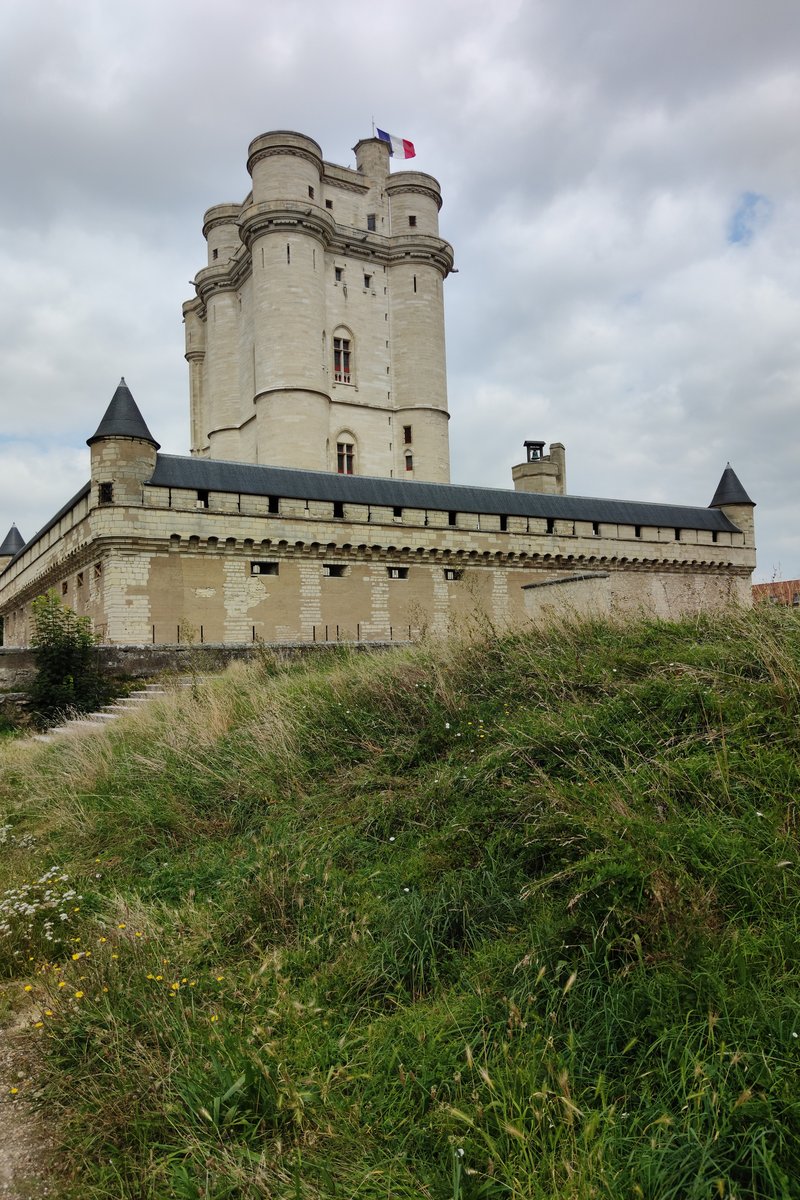
The Château de Vincennes is the largest surviving medieval royal castle in France — a vast 14th-century fortress on the eastern edge of Paris that grew from a royal hunting lodge in the woods into the most ambitious stronghold the French crown ever built. Where the Loire châteaux are pleasure palaces and Versailles a single grand vision, Vincennes is unapologetically a fortress: a kilometre of curtain wall, six tall towers, a deep dry moat, and at its heart the donjon — a 52-metre keep that is the tallest medieval fortified keep in Europe. Begun in 1337 under Philippe VI and completed in 1369 under Charles V, it was designed at once to defend the king and to house the government of France.
Inside the great keep, Charles V created a fortified royal residence on a scale nothing else in medieval Europe could match. The king lived, studied and governed here, surrounded by his celebrated library and the apparatus of the state, the keep functioning as palace, treasury and seat of power in one tower. Beside it rises the Sainte-Chapelle de Vincennes, commissioned in 1379 to hold relics of the Passion in imitation of the royal chapel in Paris. A masterpiece of Flamboyant Gothic, it was built and decorated over nearly two centuries and is lit by some of the finest Renaissance stained glass in France — a soaring, luminous counterpoint to the martial mass of the keep.
Vincennes is also a fortress of memory. After the court drifted west to the Louvre, Versailles and the Loire, the castle found a long second life as a state prison, holding figures such as Diderot, the Marquis de Sade and Mirabeau within its walls. Later still it served as an arsenal and a barracks, and it remains a French monument historique rather than a UNESCO site — a working layer of French history standing intact on the Métro at the end of Line 1. The entry ticket is open-date: you simply choose your visit date and walk straight in any time during opening hours.